- Beauty, Skin & Hair Care Peptide
- Skin Rejuvenation Peptide
- Growth Hormone & Performance Research
- Weight Loss & Metabolic Health Research | BIOVEA PEPTIDE®
- Organ Support Peptides
- Cognitive Health & Nootropics
- Recovery, Healing & Regeneration
- Muscle Growth & IGF Peptides
- Longevity & healthy Aging Peptides
- Immune System & Inflammation Peptides
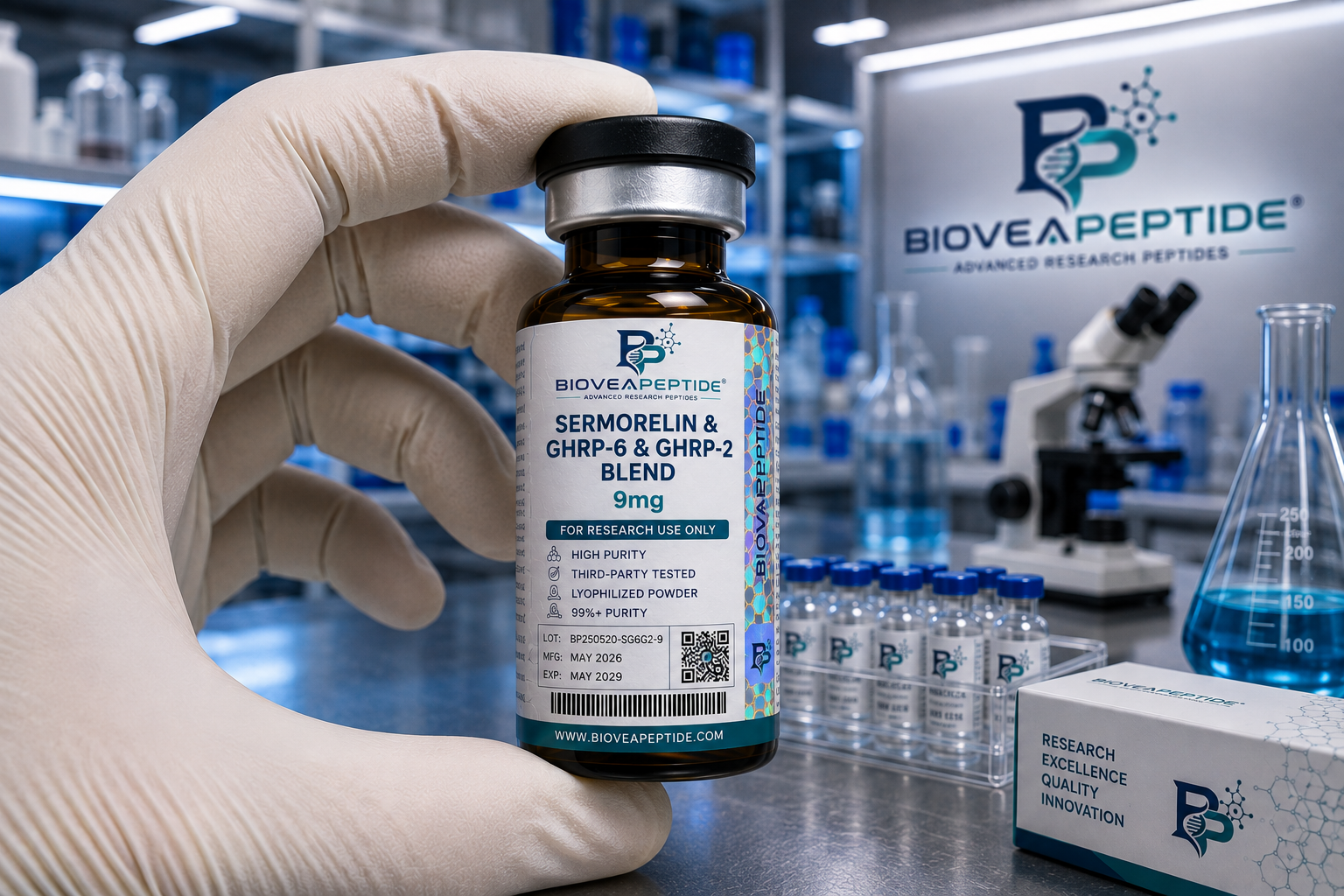
Sermorelin & GHRP-6 & GHRP-2 Blend (9mg)
$80.00
Purchase Sermorelin & GHRP-6 & GHRP-2 Blend (9mg), a premium laboratory-grade triple-peptide blend for advanced growth hormone, endocrine, and metabolic research. High-purity, laboratory-tested quality for scientific studies. For research use only.
Buy Now
Description
Description
Sermorelin & GHRP-6 & GHRP-2 Blend (9mg) is an experimental multi-peptide research formulation combining three distinct peptide research compounds: Sermorelin, GHRP-6, and GHRP-2. The formulation provides researchers with a laboratory model for investigating peptide–receptor interactions, GHRH and growth-hormone-secretagogue signaling, receptor biology, molecular endocrinology, cellular communication, signal transduction, and peptide pharmacology.
Each component has a distinct molecular structure and receptor-associated research profile. Studying these peptides within a combined research formulation can support investigations into different peptide signaling systems, receptor interactions, molecular recognition, and downstream cellular pathways.
For Research Use Only. Not intended for human or veterinary use, consumption, diagnosis, treatment, or prevention of disease.
Understanding the Peptide Components
Sermorelin
Sermorelin is a GHRH-derived synthetic peptide investigated in laboratory research involving GHRH receptor biology, peptide signaling, molecular endocrinology, and receptor-mediated cellular pathways.
Research areas may include:
- GHRH receptor biology
- Peptide–receptor interactions
- Growth-hormone-related molecular signaling
- Molecular endocrinology
- Peptide structure–function research
- Receptor pharmacology
- Cellular signaling
- Peptide chemistry
GHRP-6
GHRP-6, or Growth Hormone-Releasing Peptide-6, is a synthetic peptide investigated in research involving growth hormone secretagogue receptor (GHS-R) biology, peptide signaling, receptor pharmacology, and molecular endocrinology.
Potential research areas include:
- GHS-R receptor biology
- Peptide–receptor interactions
- Growth-hormone-related signaling
- Molecular recognition
- Receptor pharmacology
- Cellular communication
- Signal transduction
- Experimental endocrine biology
GHRP-2
GHRP-2, or Growth Hormone-Releasing Peptide-2, is another synthetic peptide studied in experimental research involving GHS-R-associated signaling, peptide–receptor interactions, molecular recognition, and receptor pharmacology.
Research areas may include:
- GHS-R signaling
- Peptide receptor biology
- Ligand–receptor interactions
- Signal transduction
- Intracellular signaling
- Molecular recognition
- Cellular response mechanisms
- Experimental peptide science
Multi-Peptide Signaling Research
The Sermorelin & GHRP-6 & GHRP-2 Blend provides researchers with a three-component experimental model involving GHRH-derived and growth-hormone-secretagogue peptide systems.
Potential laboratory investigations include:
- GHRH receptor signaling
- GHS-R receptor signaling
- Peptide–receptor interactions
- Receptor–ligand research
- Molecular recognition
- Intracellular signaling
- Cellular communication
- Signal transduction
- Protein–peptide interactions
- Peptide structure–function relationships
- Comparative peptide research
Because this is a multi-component formulation, researchers should distinguish between the characteristics of each individual peptide and those of the finished blend when evaluating experimental findings.
Receptor Biology & Molecular Endocrinology
The three peptide components provide distinct experimental models for studying peptide-mediated endocrine signaling and receptor biology.
Relevant research fields include:
- GHRH receptor biology
- GHS-R receptor biology
- Receptor–ligand interactions
- GPCR signaling
- Molecular endocrinology
- Peptide pharmacology
- Endocrine receptor research
- Cellular response mechanisms
- Intracellular signaling
- Molecular pathway analysis
Experimental observations depend on the biological model, receptor expression, assay methodology, controls, and analytical conditions.
Peptide Chemistry & Molecular Biology
The formulation can also support research examining how structurally distinct peptides interact with biological receptors and signaling systems.
Researchers may investigate:
- Peptide chemistry
- Peptide structure–function relationships
- Molecular recognition
- Protein–peptide interactions
- Receptor binding research
- Biomolecular interactions
- Peptide stability
- Chemical biology
- Molecular pharmacology
- Experimental peptide science
These research areas contribute to broader scientific understanding of peptide structure, receptor recognition, and molecular signaling.
Laboratory Research Applications
Potential research applications for Sermorelin & GHRP-6 & GHRP-2 Blend (9mg) include:
- GHRH receptor research
- GHS-R receptor research
- Peptide–receptor interaction studies
- Receptor signaling research
- Growth-hormone-related molecular research
- Molecular endocrinology
- Peptide pharmacology
- Cellular signaling
- Cellular communication
- Molecular biology
- Peptide chemistry
- Biochemical research
- Molecular pharmacology
- Experimental peptide science
- Preclinical research
Researchers should establish experimental conditions, controls, analytical methods, storage requirements, and handling procedures according to validated laboratory protocols and applicable institutional requirements. This description does not constitute an experimental protocol or recommended method of use.
Research Material & Quality Considerations
Reliable peptide research depends on appropriately characterized research materials. Researchers evaluating Sermorelin & GHRP-6 & GHRP-2 Blend (9mg) should consider documentation associated with the applicable production batch.
Relevant documentation may include:
- Component identification
- Peptide identity
- Purity information
- Batch identification
- Analytical testing
- Molecular characterization
- Certificate of Analysis, where available
- Storage specifications
- Product documentation
For a multi-peptide formulation, researchers should review available documentation for the individual components and finished blend before incorporating the material into experimental investigations.
Why This Peptide Blend Is Relevant to Research
Sermorelin & GHRP-6 & GHRP-2 Blend (9mg) combines three experimentally studied peptide systems with distinct molecular characteristics and receptor-associated research profiles.
Its research relevance spans:
- GHRH receptor signaling
- GHS-R receptor signaling
- Peptide–receptor interactions
- Receptor biology
- Molecular endocrinology
- Growth-hormone-related molecular research
- Peptide chemistry
- Cellular communication
- Molecular biology
- Receptor pharmacology
- Biochemical research
- Experimental peptide science
This makes the formulation relevant to multidisciplinary laboratory investigations involving peptide signaling, receptor biology, molecular pharmacology, and experimental endocrinology.
Research Use Only
Sermorelin & GHRP-6 & GHRP-2 Blend (9mg) is supplied strictly as a laboratory research material.
It is not intended for human or veterinary use and should not be represented as a medication, dietary supplement, performance product, or therapeutic treatment. Experimental findings should not be presented as established evidence of safety or efficacy for human use.
Researchers are responsible for ensuring that research materials are handled, evaluated, stored, and disposed of according to appropriate laboratory procedures, institutional requirements, and applicable regulations.
Research Use Only. Not for Human or Veterinary Use.